
Choose AutoTransport.com to Ship a Car in Quincy, Massachusetts.
Car Shipping in Quincy, Massachusetts
At autotransport.com, we believe that transparency makes car shipping in Quincy more efficient. We have been shipping cars for quite some time now. During our years of operation, we have accumulated resources and experience that help us make car shipping in Quincy smoother and faster. When clients come to us looking to have their cars transported to Quincy, we ask for their details including their contact information, pick up address, drop off address, and other information. All this information is sensitive; that is why we keep the privacy of our car shippers secure. We do this by encrypting our database. The transport of cars can be daunting at first, but with the right car shipping company, it gets more comfortable and more efficient.

Start Your Transport
Process Today
We can have your vehicle loaded and ready to go in under 24 hours upon starting your quote! Your logistics professional will be with you every step of the way.

Quincy, Massachusetts Car Shipping
Ship a Car to Quincy Securely
Your Quincy, Massachusetts car transport specialists.
Quincy Auto Transport Planning
Quincy is a city situated in Norfolk in the US state of Massachusetts. It is one of Boston’s immediate southern suburbs and part of the Boston Metropolitan area. Interstate 93 and US route 1 run South0 North of Quincy travel concurrently starting at the southwest part of the city. At the southwestern part of the city, Randolph border divides the line between southern and northern halves of the exit 5 cloverleaf interchange.
- A+ Rated Drivers
- Full Cargo Insurance
- 24/7 Availability
- Competitive Pricing
- National Coverage
- Vehicle Tracking
We always plan a clear route for you.
How Much It Costs to Ship a Car to or from Quincy
Cost is the first question on almost every call, and the honest answer is that it depends on distance more than anything else. Published long-distance moves to and from Massachusetts run between $670 and $1,945 for an operable vehicle on an open carrier. That range reflects mileage: rates work out to roughly $0.80 per mile on shorter hauls and settle to about $0.65 per mile once a route passes 1,000 miles.
Four things move a quote away from the baseline: vehicle size, whether it runs and rolls, open versus enclosed equipment, and how much flexibility there is in the pickup window. An inoperable vehicle needs a winch and costs more. A dually or a lifted truck takes the space of more than one car and is priced that way.
Very short hauls are the exception. Below roughly 650 miles the per-mile arithmetic stops describing what a carrier actually needs to run the load, so those moves are quoted on their own rather than off a table.
Routes and Transit Times from Quincy
I-90 is the corridor that shapes most Massachusetts moves. It runs from Boston through Worcester and Springfield to the New York line — the state’s only true east-west freight route.
That matters for a practical reason: carriers build routes around the interstates, so a pickup close to the corridor gets scheduled faster and usually cheaper than one an hour off it. If Quincy sits away from the main line, expect a slightly wider pickup window rather than a higher price.
Once loaded, a truck covers 400 to 500 miles in a day — that figure comes from federal driving-hour limits and is not negotiable. Use it to sanity-check any transit estimate you are given: a 2,000 mile move that is promised in two days is not a promise anyone can keep.
Pickup and transit are two separate clocks. Assigning a carrier to a Quincy address typically takes one to five days depending on the lane and the season; the drive begins after that.
Open or Enclosed: Choosing Equipment for a Massachusetts Move
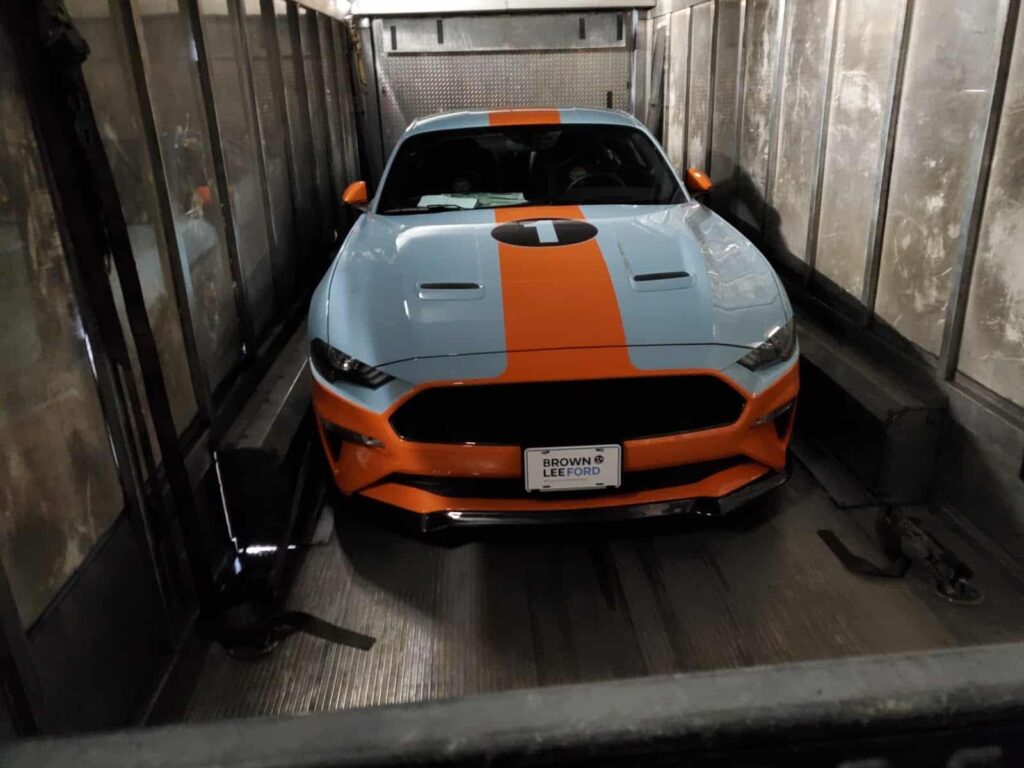
Open transport is what roughly nine out of ten vehicles ship on. It is the standard eight to ten car trailer, it is the cheapest option, and it is what new cars ride on from the factory to the dealer. Enclosed transport costs meaningfully more and exists for vehicles where road exposure is the thing you are paying to avoid.
Nor’easters between December and March can close I-90 and shut Logan for a day or more, and Boston’s snow-emergency parking rules make residential pickups genuinely difficult in winter. Cape Cod and the islands add a seasonal summer surge, and ferry-served destinations need separate arrangements.
The practical test is simple: if the vehicle is insured for its replacement cost and you would be untroubled by a stone chip, ship it open. If a single chip would matter — a collector car, a show car, a recent respray — pay for enclosed.
Preparing Your Vehicle for Pickup
Wash the vehicle before the driver arrives. This is not cosmetic — the condition report at pickup is the document that settles any damage claim later, and dirt hides exactly the scratches that become disputes.
About a quarter of a tank is right: enough to load, unload and drive away, not so much that you are paying to freight gasoline across the country. Take out the toll tag, fold the mirrors, remove or retract the antenna and clear personal property from the vehicle, which a carrier’s cargo insurance does not cover.
Turn the alarm off or tell the driver how to. A siren going off repeatedly in transit is a genuine problem on a loaded trailer. Then photograph all four corners, the roof and the wheels on pickup day and hold on to your signed bill of lading — between them, those records settle nearly every disagreement that comes up.
Quincy Car Shipping: Common Questions
How much does it cost to ship a car to or from Quincy?
Long-distance moves to and from Massachusetts generally fall between $670 and $1,945 for a running vehicle on an open carrier. Rates run near $0.80 per mile on shorter hauls and around $0.65 per mile beyond 1,000 miles. Vehicle size, operability, trailer type and how flexible your dates are all move the final figure.
How long does it take to ship a car to or from Quincy?
There are two clocks. Assigning a carrier to a Quincy pickup usually takes one to five days. Once the vehicle is loaded, a truck covers 400 to 500 miles a day under federal hours-of-service limits — so a regional move is one to three days on the road and a cross-country move is seven to ten.
Do I need open or enclosed transport?
Open transport suits around nine in ten vehicles and costs less. Choose enclosed for classics, low-clearance cars, recent restorations or anything where paint condition is part of the value — and consider it for a winter move through Massachusetts if road salt is a concern.
Can the truck come to my door in Quincy?
Usually, but not always. A full-size carrier is around 75 feet long and cannot manage narrow residential streets, low branches or tight cul-de-sacs. When an address will not work, the driver arranges to meet nearby — a supermarket or shopping-center lot is standard practice and does not change the price.
Is my vehicle insured while it is being shipped?
Yes. Every carrier we assign has active cargo insurance in force, and you can request the certificate before pickup. Personal items left in the vehicle are not covered by that policy, which is one of the reasons to empty the car first.
Will you ship a non-running vehicle?
Yes, with notice. An inoperable vehicle needs a carrier with a winch and takes longer to load, so it costs more and needs to be declared when you book. Tell us whether it rolls, steers and brakes — those three things decide what equipment is sent.